
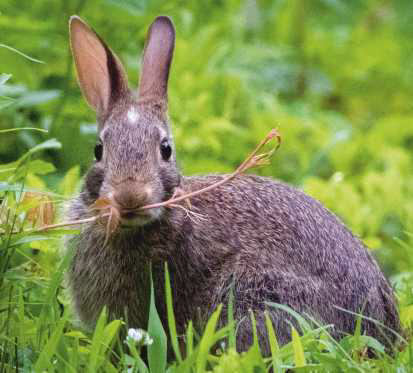
Summertime is bunny time. Eastern cottontail rabbits are common in parks and backyards, even more so in warmer months when it’s very common to encounter a nest of baby rabbits or, nowadays, see young rabbits out and about feeding on green vegetation.
“And even though they just might take a liking to some of your garden plants, rabbits–especially baby rabbits–are pretty darn cute,” said Art Weber, Metroparks nature photographer. They also are considered the most important small game mammal throughout their range, which is virtually all of the eastern United States.
As a game species, their best defense is to use their speed to run and hide as quickly as possible. They are built for detecting potential predators in time to escape. Their eyes are positioned to give them nearly a complete field of vision, including above them. And, of course, their “rabbit ears” can rotate to accurately detect the direction of an attack.
“If you do come across a rabbit nest, a grass-covered depression or shallow hole in the ground with a crowd of as many as seven young huddled inside, the rule of thumb is to leave it alone. Leave it undisturbed,” Weber said.
It is natural for the adults to stay away from the nest through daylight hours, returning under the cover of darkness to check on the young and for the female to suckle them. The young are in the nest for up to 30 days.
A great local resource for additional and very useful information on rabbits and their nests is the Nature’s Nursery website, Natures-Nursery.org.
Above, a young rabbit feasts on grasses growing in a rural fenceline. The photograph was captured by Weber.