
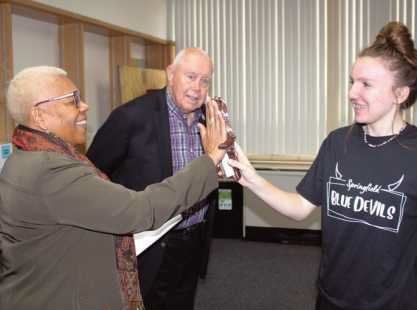
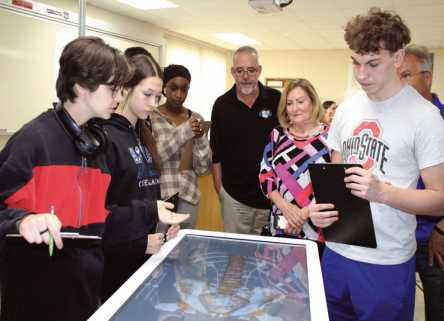
On April 21, Springfield Local Schools welcomed area officials to the district, highlighting a broad spectrum of educational offerings the district offers its students.
Whether a student is performing a virtual dissection using an Anatomage Table in Mrs. Mahoney’s high school science classes; using 3D printing technology in Mr. Ransford’s middle school STEAM lab to construct prosthetic hands; using one of the district’s PRAIRIEs to assist NASA with data collection in Mrs. DiSalle’s intermediate class, or predicting the mass of a cookie, Springfield’s young scientists are learning in ways most adults never thought or imagined possible when they were their ages.
Vocational pathways in business and hospitality tourism are already offered— state and local officials viewed what students are, and will be learning when additional on-site offerings such as construction (grades 8-10, 12), phlebotomy and pre-engineering are infused in the such as construction (grades 8-10, 12), phlebotomy and pre-engineering are infused in the 2023-24 curriculum.
For younger musicians, Boomwhackers and Recorders add high notes to their lives; the art that all students create is being enhanced through both their vision and the gained perspective provided through technology.
Today’s language arts classes allow students to hone communication skills in several languages–and use some of those skills on Blue Devil Radio–which is one of just 1 percent of high schools nationwide that provide an actual onsite radio station/learning lab for budding journalists.
Mathematicians are hard at work and many classroom activities cross curricular boundaries to challenge all levels of learners. Mrs. Turner’s middle school entrepreneurs are managing a weekly “coffee cart” that employs many newfound business and life skills that encourage future successes.
SLS classrooms are without walls and limitations— all enriched by teachers who use the natural habitat within the community to provide students a robust education that supports various Ohio Department of Education content standards.
PreKindergarten to grade 12 students also receive memorable learning experiences that equip them to explore the things easily within their reach and for the global opportunities that exist well beyond their current boundaries.
One Size Doesn’t Fit All As those who joined us on the tour witnessed, the learning needs and capabilities of each student varies; districts such as Springfield educate children with an abundance of physical, emotional and learning challenges. Meeting the individual needs of each student simply does not comply with a “one-sizefits- all” formula.
In many cases, the requirements of Individualized Learning Plans far exceed the funds received, yet the services are necessary to educate the whole child.
And, while some students actually did well when learning in virtual/hybrid learning environments, others did not, which places an even higher demand on the skills and resources of teachers, interventionists, school counselors and support staff.
Elected officials who attended were Austin Serna, legislative aide to U.S. Congresswoman Marcy Kaptur; State Senator Paula Hicks-Hudson; State Board of Education member Teresa Fedor; Springfield Township Trustees Tom Anderson, Bob Bethel and Andy Glenn; and Administrator Mike Hampton, Holland Mayor Lee Irons and three board of education members Ev Harris, Sherri Koback and Ken Musch.
According to Superintendent Matt Geha, “Staying on a strict timeline became a challenge as few wanted to step away from what they were seeing during each leg of the tour.”
In total, four of the district’s seven facilities were open to lawmakers, all of whom left with a new perspective on public education. Conversations took place as officials toured each site and a question and answer was held following the visits at the new Ev Harris Administrative and Educational Complex.
“At the state and federal levels, many proposals are currently in committee that will have a significant impact on the future of public education,” said Mr. Geha, adding, “Before casting your votes we hoped to share our expertise on topics ranging from curricular offerings to fair and equitable school funding.”