
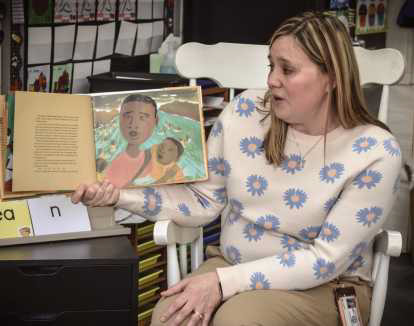
In a brightly lighted second- grade classroom tucked inside Dorr Elementary, the hum of curiosity and excitement is unmistakable. Students eagerly flip through the pages of their books, share ideas aloud and tackle writing prompts with newfound confidence. At the center of it all is Kelly Deisher, a dedicated educator who has embraced the power of the Fishtank ELA curriculum to transform how her students read, write, think and communicate. Mrs. Deisher’s class was alive with curiosity and conversation.
“For second grade, Fishtank starts with building background engagement and accessing prior knowledge,” Deisher explains. “We always set the purpose of our lesson at the beginning of each day, introduce key vocabulary and then dive into our story. We finish by discussing key questions and working through daily task questions that challenge students to think deeper and respond in complete sentences.”
That clear, consistent structure is just one of the reasons Deisher was drawn to Fishtank ELA. But it was also the program’s alignment with the Science of Reading, its inclusion of physical student texts and the intentional integration of reading and writing that sealed the deal.
“We were looking for something that was engaging, rigorous and effective,” she says. “Fishtank checks all the boxes. It’s easy to use in our everyday teaching and keeps us focused on the standards.”
Engaging Readers, Empowering Writers
Since adopting the curriculum, Deisher has witnessed a powerful shift in student engagement and achievement.
“My students have loved the books and topics we’ve explored this year,” she shares. “Even my reluctant readers are raising their hands, wanting to read aloud. They’re excited about the next chapter, the next unit, the next discovery.”
When I visited her classroom on April 17, Deisher shared that her students were deeply engaged in reading and studying “Lost Boys of Sudan,” a powerful unit that sparked thoughtful conversations about resilience, empathy and global awareness.
From narratives and opinion pieces to research-based projects, writing is a central thread woven throughout Fishtank’s units. “Their writing has really improved,” Deisher notes. “They’re using stronger sentence structures, better vocabulary and they’re becoming more confident communicators.”
One standout moment? The unit featuring “Pinky and Rex”–a story that captivated her entire classroom. “They couldn’t get enough. They were all-in, asking questions, talking about the characters and wanting to read more.”
Creating a Collaborative Literacy Community
Within Deisher’s classroom, discussion is not just encouraged–it’s essential. “Classroom conversation plays a huge role in how my students connect to what we’re reading,” she says. “They build on each other’s ideas and start to see different perspectives.”
This open exchange of thoughts and interpretations, paired with a clear daily learning goal, helps students construct deeper meaning and feel ownership over their learning. It also fosters a strong sense of community and collaboration–a core value in Deisher’s teaching philosophy.
Overcoming Challenges and Looking Forward
No curriculum implementation is without its challenges. For Deisher, pacing was an initial hurdle–figuring out how to fit everything into a short school day while maintaining the integrity of each lesson. “But once you learn how to adapt it to your students’ needs and find your rhythm, it becomes second nature,” she says.
As she looks ahead, Deisher is excited to continue evolving her approach to literacy instruction. “Fishtank gives us a strong foundation, but there’s always room to grow and enhance the experience,” she says. “I want to keep encouraging critical thinking, fostering curiosity and creating a joyful space for learning.”
A Spark That Sticks
In Kelly Deisher’s classroom, literacy isn’t just a subject–— it’s a launchpad for discovery, creativity and connection. Thanks to her thoughtful implementation of the Fishtank ELA curriculum, her second graders aren’t just reading stories–they’re living them, learning from them and writing their own.