

Area residents who enjoy visiting the Metroparks, especially over the past 20 months, may not realize everything that goes on behind the scenes to maintain the ecosystem and nature they partake in while walking the numerous trails.
At the board’s October 27 meeting, Karen Menard, Metroparks research and monitoring supervisor, and Scott Abella, founder and ecologist of Natural Resources conservation, presented an update on research and monitoring efforts throughout the park system.
Vegetation monitoring began in 2018 when the program was fully implemented and is repeated every three years, Ms. Menard explained. “It’s a critical part of our framework.”
The adaptive management framework is designed to track changes in ecological conditions, plant communities and species distribution patterns among habitats.
There are 138 monitoring plots in the park system divided into three regions: Oak Openings, Maumee River and tributaries and Lake Erie marshes and coastal plains. The greatest number of plots is in Oak Openings with 107, followed by the Maumee River, 21 and Lake Erie, 10.
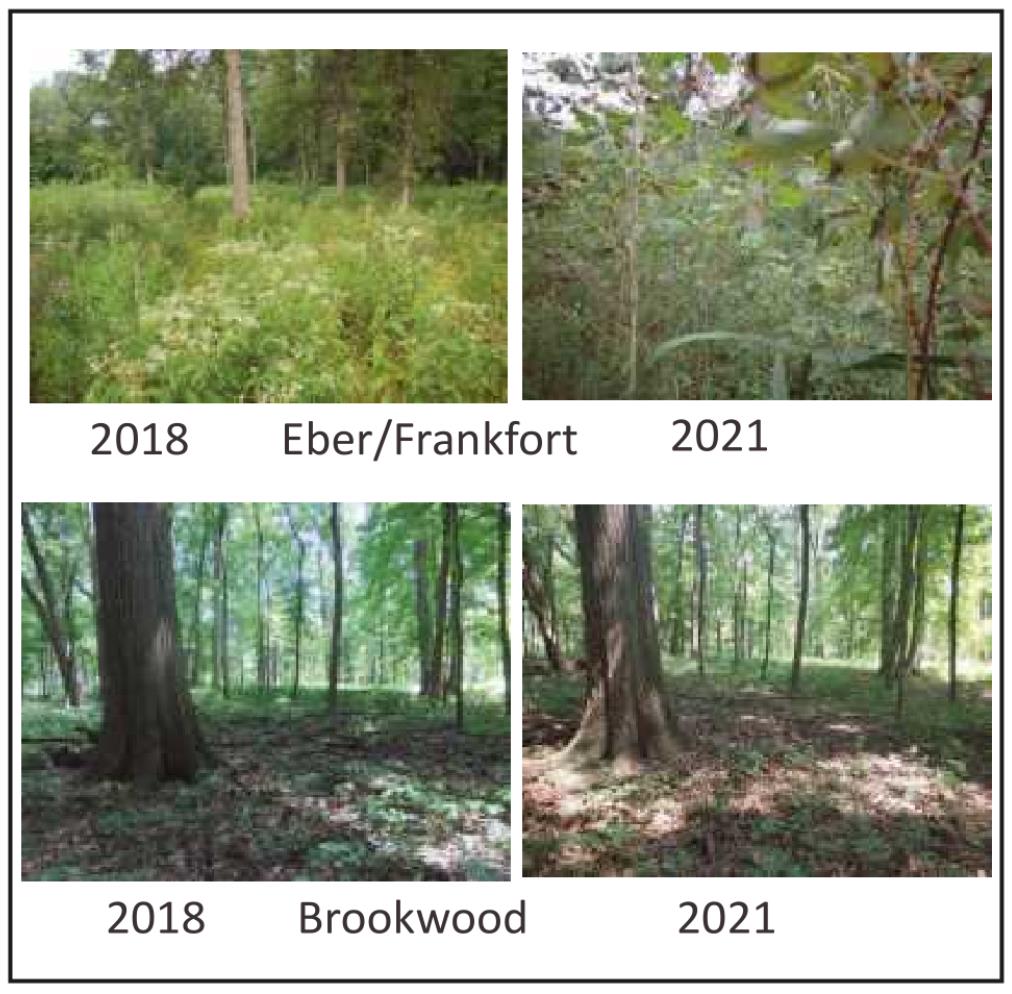
Plots are identified using GPS coordinates and permanent field markings, Ms. Menard said, and each plot is about 0.12 acres. Information collected includes abundance by plant species and tree basal area by species’ reference photos taken for comparison every three years.
Tim Schetter, director of natural resources, said, “It’s hard to overstate the challenge of this work. Some of these sites are in hard-to-reach areas.”
He credits Ms. Menard and her small staff. “It’s a remarkable feat to be able to do this work,” he said, adding that in trees alone, they monitored 5,000.
Ms. Menard agreed that the work would not be possible without the help of two interns who assisted with locating plots and monitoring them over the past three years. “We definitely needed their help.”
The team also needed help just getting to some areas, relying on maintenance staff in some cases to use a grinder to create a path to the plots.
She displayed several photos taken in year one and again of the same location and same season in year three. “You can see there is a difference.”
They found several new species including slender showy goldenrod and narrow leaved wild leek.
“In total, we observed 854 plant species in 17 acres of plots. The plots contain 32 percent of Ohio’s flora,” Mr. Abella noted, adding that 60 state-listed rare plants were documented.
Metroparks’ species are doing very well in comparison to two national parks, Cuyahoga and Yellowstone. The park district has 91 percent of the species found at Cuyahoga and 56 percent of Yellowstone’s, he pointed out. Like all restoration ef
Like all restoration efforts, bringing areas back to their predevelopment will take time, he said, citing Oak Openings as an example. Up until the early 1930s, the land was primarily used for farming and there are still examples of wire fencing that tied to trees, and findings of old buckets, pots and other items on land northeast of Monclova Road at State Route 64.
Restoring the ecosystem of the region isn’t without challenges. The amount of organic matter needed in the soil is less than half in old farm fields. “That’s why some maple
“That’s why some maple trees and other species are not surviving,” explained Mr. Abella, and he estimates it would take 250 to 300 years for organic matter to accumulate sufficiently.
Another threat, which the Metroparks has had more success with is the deer population.
He showed photographs of eight plots in 2002 prior to a deer cull and compared them to 2021. Deer eat the foliage and damage seedlings, making it hard for plants to survive.
Mr. Schetter explained that significant adverse effects occur when the deer count exceeds 20 per square mile. “You see a decline in biodiversity, changes in bird communities and a landscape that has a disproportionate effect on other species.”
Mr. Abella said adding to the deer overpopulation over the years is a lack of natural predators. “Without wolves or other predators, their population has exploded.” However, since control
However, since controlling the population with periodic deer culls, Metroparks has seen a return to forest floor plants such as wild geranium and a decline in damaged oak seedlings.
In addition to managing deer, the park district has begun conifer management practices.
Although the pine forests at Oak Opening are beautiful, they are not native to the region.
Removing some conifers has resulted in a six-fold increase in plant species in one plot, Ms. Menard said. “We went from 10 species in 2018 to 61 in 2021,” she added.
On another plot, the jump was 13-fold from five in 2018 to 66 species this year. Emerging plants include the endangered Drummond dwarf bulrush, threatened racemed milkwort and the potentially threatened prickly pear.
Ms. Menard said the team’s next steps will be to fully analyze the 2021 monitoring data, comparing it to 2018 with a special focus on urban parks such as Middlegrounds and Manhattan Marsh.
She will write reports using the latest data and establish the first documented biodiversity inventories for Toledo. “This will contribute to public education and management needs,” she added.
Other Business
In other business, the park commissioners: •Awarded Comte Con
•Awarded Comte Construction of Toledo a contract for replacement of the maintenance building at Secor park for an amount not to exceed $592,500.
Joe Fausnaugh, special projects manager, said the original building was severely damaged in April by a fire. He noted the original cinder block building with a low roof line had not been “very adequate so it didn’t make sense to repair it.”
Replacing it will be a pre-engineered metal building 15 feet longer and four feet deeper with taller bay doors to accommodate equipment.
•Amended appropriations and resources to reflect updates for grant programs. The revenues total $68.81 million and appropriations, $58.2 million.
•Authorized Allen Gallant, director of community development, to seek a grant for $4,000 through the Ohio Department of Natural Resources division of forestry. The funds would be used to provide necessary equipment for fire management practices, he explained.
•Recognized executive director Dave Zenk who is celebrating his 15th year as a Metroparks employee.
“We are honored to recognize Dave,” said Scott Savage, board president, noting that since his arrival, there have been a lot of changes and growth of the park district.
•Paid bills for September in the amount of $2.46 million.
The next park commissioners meeting will be at 8:30 a.m., Wednesday, November 17, at Brookwood Metropark, 5604 Swan Creek Drive, Toledo, and is open to the public.