
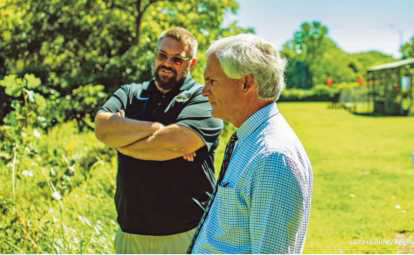
U.S. Representative Bob Latta stopped by the Lucas County Engineer’s Office September 8 to learn more about ditch and drainage projects that are increasing the quality of life in northwest Ohio. He also visited Smith Ditch in Sylvania Township, the site of a two-stage ditch project completed by the engineer’s office in 2020.
Lucas County Engineer Mike Pniewski led a presentation on two stage channel ditches, responding to the congressman’s questions about costs and benefits to residents, farmers and the environment.
“We appreciate Congressman Latta’s visit to our office,” Mr. Pniewski said. “Without his support of the Great Lakes Restoration Initiative, Lucas County’s drainage improvement program including the use of the two stage ditch best management practice would not have been possible. We look forward to working with the congressman and his staff to develop policies and programs that move our region forward.”
Often called a “ditchwithin- a-ditch,” a two-stage ditch is a widened ditch that establishes benches within the ditch, a low-flow channel and then a higher, vegetated bench that is flooded during higher flows. The vegetation slows the runoff and water flow and helps to capture sediment and other algae-feeding nutrients like phosphorous, while also increasing the storage capacity for flooding.
In August, the two-stage ditch was added to a list of eligible best management practice projects for H2Ohio funding due to its effectiveness in improving water quality and decreasing the risk of flooding.
The county has completed four two-stage ditches, with a fifth (Van Fleet) in progress and a sixth in the petition process.
Rep. Latta has been an advocate for cleaning up Lake Erie and voted to support the Great Lakes Restoration Initiative Act of 2019.
“The Great Lakes are the crown jewel of our region,” he said. “They are the largest freshwater system in the world and protecting Lake Erie and the other lakes has always been a focus of mine in Congress. Communities in northwest Ohio rely on the Great Lakes for drinking water, and they are the source for jobs, recreation, and more.”