
The Toledo Museum of Art, 2445 Monroe Street, Toledo, will feature “Marisol: A Retrospective,” March 2 through June 2.
Marisol (born María Sol Escobar, 1930, Paris) achieved renowned acclaim in the 1960s when thousands would line up to see her often life-size artworks. When she retreated from the art world and shifted her artistic focus in the late 1960s and 1970s, her fame waned despite continuing to practice.
The exhibition presents the most comprehensive digest of the artist’s career to date with approximately 244 objects that invite visitors to consider her inspiration, influence and impact. The exhibition pairs recognizable self-portraits and sculptures with lesser-known works to present her evolving ideas and the important cultural issues of the time that were often woven into her art.
About the exhibition:
Sketches, self-portraits, source materials, studies and personal photographs will acquaint visitors with one of the most popular yet enigmatic artists of the 1960s.
Marisol drew inspiration from the robust, experimental arts movement thriving in postwar New York as well as the larger cultural changes in the world around her. Her works share personal experiences and offer commentary on the issues of that day. Underwater films, photographs and works from her public art practice will introduce visitors to aspects of her career that are often overlooked.
The artwork in the exhibition is accompanied by an extensive collection of ephemera and showcases Marisol’s work in nine themes, including:
•Material experimentations features works in media for which she is lesser known. The artist produced many of those works early in her career. Among them is “The Hungarians” (1955), made of polychromed wood and a metal cart.
The work speaks to her persistent addressing of topical issues such as migration and immigrant experiences. “Figuras” (1959), from TMA’s collection, is a distinctive and captivating cast bronze sculpture that stands on a wooden base.
•In portraiture from personal to political, the graphite and oil on wood “Portrait of Georgia O’Keeffe with Dogs” (1977) presents one of Marisol’s inspirations in her older age. The source photograph, also taken by Marisol, is presented in the exhibition and visitors can compare the same subject across two media.
•Mutable forms, mutable selves includes “Baby Boy” (1962-1963) and “Baby Girl” (1963), two wood and mixed media sculptures that are distinct but related. Jessica S. Hong, TMA’s senior curator of modern and contemporary art, said the works “speak to the sociopolitical happenings of the day, from the pressure to shape nuclear families to the pending breakout of nuclear warfare.”
•Into the swim features depictions of water and fish, often inspired by Marisol’s ecological concerns, as in “The Fishman” (1973).
Other themes include art in motion, the body in pieces, late in life drawings, sculptures for public spaces and troubling doubles.
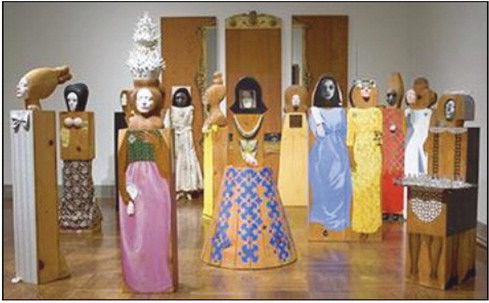
“The Party” (1965-66), an assemblage of 15 freestanding, life-size wooden sculptures, anchors the exhibition and allows visitors to delve into her personality and the social climate of the time. The work, from TMA’s collection, depicts guests at an event that the artist describes as “a very elegant ball.” A butler and a society lady are among the attendees–all bearing Marisol’s face. Although all have been invited to the lavish party, they fail to connect. Instead, they encounter isolation in a crowd–an experience that was all too familiar to the artist.
“Marisol’s work is wellrepresented in the TMA collection, and we are pleased to be able to participate in this major retrospective to give our audience a fuller understanding of her practice and its significance. We seek, through our acquisitions and exhibitions, to contribute to expanding the canon, and this exhibition centers Marisol’s significant contributions appropriately within post-war art history in the fullest way yet,” said Adam Levine, Edward Drummond and Florence Scott Libbey director and CEO, TMA.
The exhibit is organized by the Buffalo AKG Art Museum and curated by Cathleen Chaffee, Buffalo AKG’s Charles Balbach chief curator.
The exhibition and accompanying catalogue are supported by a grant from the Henry Luce Foundation. Critical work related to this exhibition and collection was made possible in part by a grant from the National Endowment for the Humanities.