

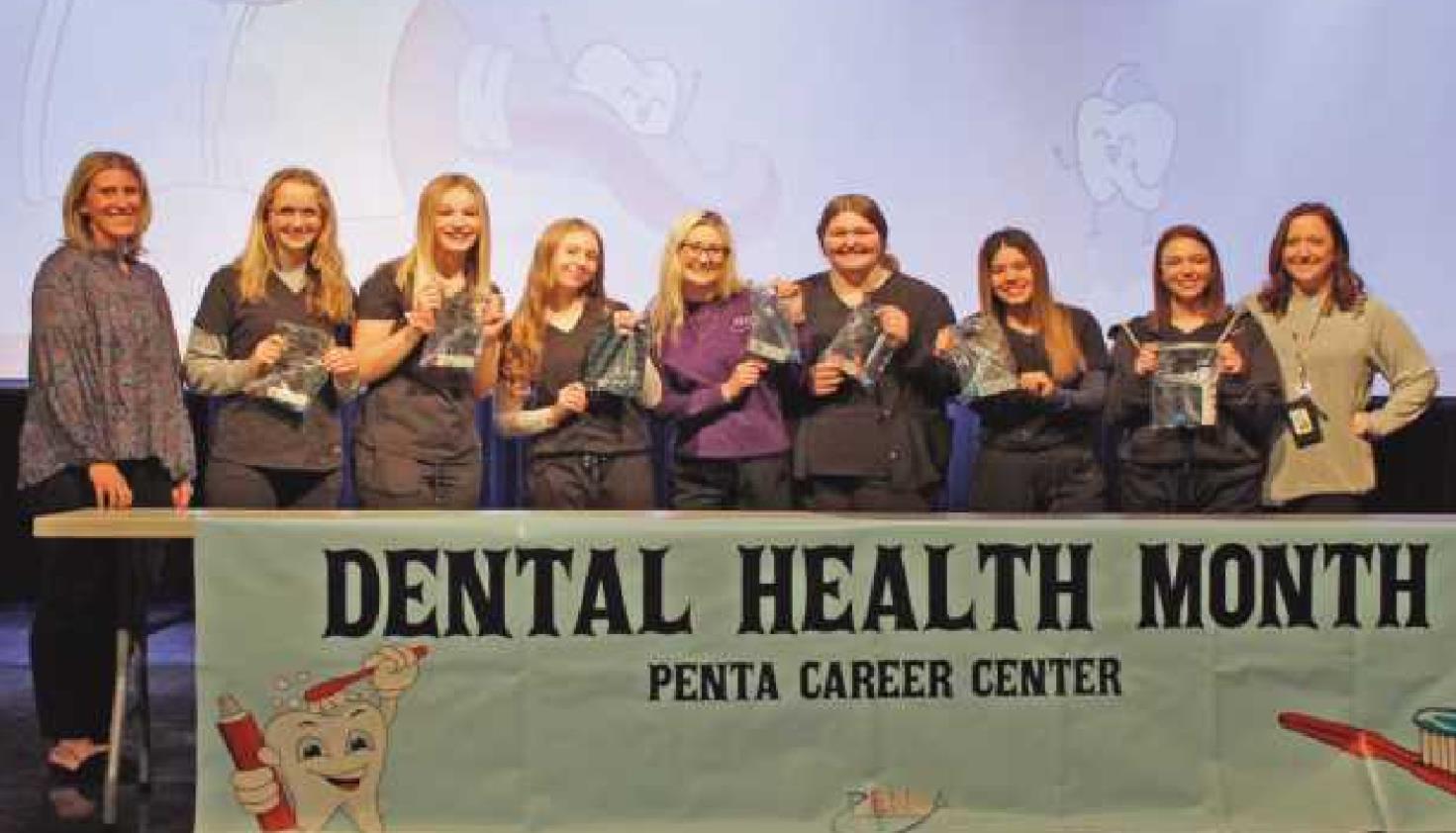
“Brush and floss or prepare for loss” is just one of the points students in Penta Career Center’s dental assistant program were trying to drive home during their oral health presentation.
On February 24, the students presented two sessions to fellow classmates on the importance and benefits of good oral health. And earlier in the month, the students traveled to Toth Elementary and Perrysburg Junior High School to deliver a program tailored to each group.
Both emphasized the need to brush and floss and were accompanied with activities promoting oral hygiene.
“Our goal is to educate the community as well as our Penta students on the importance of oral health and how it contributes to their overall health,” said Brenda Strauss, instructor.
Dental assistant seniors provided more than 300 classmates with information and demonstrations on proper brushing, flossing and the negative effects of bad habits.
Their presentation included information on the damage tongue piercings can cause, cracking the front teeth and even splitting the tongue.
To emphasize their point, students aired an interview with a working piercer.
In addition to cracking teeth, piercings can lead to gum and tooth sensitivity, and interferes with eating and swallowing.
The piercer noted that it often causes a person to speak with a lisp, adding he will do the procedure if asked, but always advises against it due to problems that can arise and the care required to keep the area properly disinfected.
Students also addressed the negative effects of vaping, a popular form of smoking among teens.
Vaping dries out the mouth and limits saliva production, which can lead to bad breath, dry mouth and an increased risk of gum disease and cavities.
In addition, the vegetable glycerin mixed with flavoring causes teeth enamel to weaken, allowing for plaque to stick to the teeth and in crevices.
Vaping can result in what is referred to as vaping tongue, which turns the tongue to a pasty white shade.
Nicotine from its use restricts blood flow to the gums, reducing the mouth’s natural ability to fight infection.
The students urged their classmates to take care of their teeth through twice-daily brushing and flossing, demonstrating the proper way to do both.
They also advised classmates to visit a dentist two times each year for cleanings and to repair any issues such as cavities, noting that even with the best oral care, plaque can still build up on teeth.
Dental assistant students chose to present the programs in February in conjunction with National Children’s Dental Health Month.
They concluded the presentation with activities and a series of “did you know” questions prepared by Brie’Ahna Nigh of Springfield Local Schools.
Did you know?
•In a lifetime, a person produces more than 100,000 gallons of saliva
•Most plaque hardens within 48 hours of formation, and within several days it will become so hard that it is almost impossible to remove
•Coconuts are a natural antibacterial food and can help reduce the risk of developing gum disease or cavities
•When you are not flossing, you miss more than 40 percent of tooth surfaces
•In a lifetime, the average American spends approximately 38.5 days brushing their teeth
•People who drink three or more cups of pop per day are 62 percent more likely to suffer from tooth decay, tooth loss and fillings than others
•People who smoke are two to seven times more likely to develop periodontal disease than non-smokers
•Piercings can result in tooth damage, tooth alignment issues, tooth decay, periodontal disease, tooth loss and bone recession
~Jane Maiolo