
Penta Career Center’s newest program may be starting out small, but it has big aspirations.
This school year, the district in conjunction with Springfield Local Schools, introduced phlebotomy.
The seniors-only program is offered at Springfield’s administrative and education complex in Holland, and is open to seniors in any of Penta’s 16-member school districts.
In its inaugural year, the program has 11 students, who are split up in morning and afternoon lab sessions. The program allows students to take academics with their member school for half days and the lab for the latter portion of the day.
Instructor Vicki Lammie, a phlebotomist, works with students who are being trained to work in a variety of settings such as hospitals, diagnostic laboratories and blood donor centers.
Unlike traditional 16-week adult education programs, in which students only have 30 successful blood draws before testing, the high school program is aiming for a much higher number.
In Ohio, 30 successful blood draws and 10 successful capillary sticks are required to take the certification exam.
Ms. Lammie said because students are enrolled for a full year, she is “pushing for 200 blood draws before graduating.”
The seniors may be much younger that their adult education counterparts, but they will have a “leg up” when it comes to experience, she explained.
In addition, where adult education students pay for the program and testing for certification, high school seniors do not. The course includes taking the phlebotomy technician exam for credentialing when they are ready.
They also will be credentialed in CPR/first aid and bleeding control.
The first aid portion came in handy early in the program when for the first few weeks of the course, students who were drawing blood became lightheaded or fainted.
Ms. Lammie was initially taken aback, having never experienced that reaction in the adult program. She quickly devised a plan of action, having another student stand right behind them and if the student felt faint, they were instructed to speak up quickly so the person behind could assist while another stepped in to complete the blood draw.
Springfield seniors Hannah Guercio and Bella Spellis admitted the first few weeks were a challenge, but now they are comfortable and even eager to draw blood and show the skills involved.
The two took visitors back to the lab room, which is similar to any other lab. There Hannah showed that training begins with patient care.
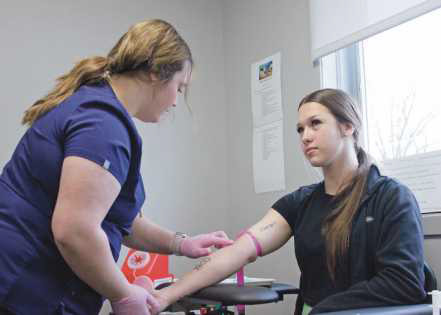
She greeted Bella and confirmed the patient’s date of birth and spelling of the last name along with arm preference before beginning the draw. She also recorded the type of draw on a paper similar to what is placed on the vial itself.
After finding the vein and prepping the site with a cotton swab, she told Bella she would feel a slight poke. Minutes later the procedure was complete and Bella’s arm was securely wrapped with instructions not to pick up any heavy objects using that arm.
Ms. Lammie explained that women are particularly prone to picking up a purse after a draw, which can cause the vein to reopen and bleed.
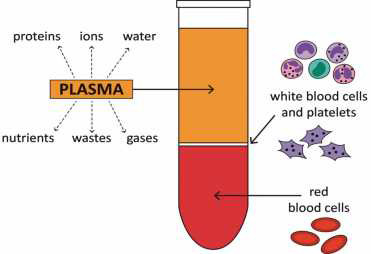
Following the draw, Hannah demonstrated how to use the centrifuge, which is a machine that spins the blood at high speed, creating a force that is strong enough to separate materials based on density.
The sample is placed in the centrifuge along with vials of equal weight to balance the machine and allowed to spin for 10 minutes.
Hannah pointed out the importance of properly balancing the centrifuge. An improperly balanced machine can cause the specimen to break or damage the machine which spins at about 3,000 rpms.
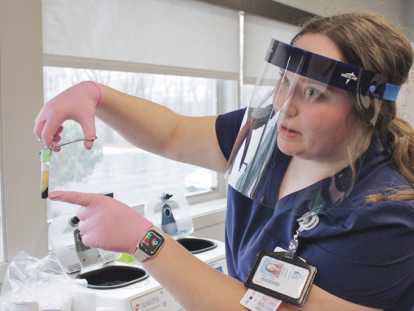
When complete, Hannah carefully removes the sample, donning a face shield for safety reasons. She shows how the centrifuge took the blood sample and separated plasma, white and red blood cells.
Using a dropper, she carefully skims the plasma from the top and places it in another container. The entire sample is then placed in a hazmat bag and deposited into a hazmat container for proper disposal.
Both are strong proponents of the program and plan to use it in the future. Hannah will be studying physical therapy at the University of Toledo in the fall, and will use her phlebotomy skills in a job to help pay for college.
Bella’s future plans will require the skills she learns in the class.
“I plan to attend Owens Community College for firefighter/ EMT so I’ll need to know this,” she said.
Ms. Lammie noted that everyone enrolled in the class has plans to work in the medical field.
When asked what their biggest challenges have been with the program, the teens had markedly different responses.
“It was a challenge to discipline myself,” said Hannah, who learned to pace herself and follow each step in the process which was more involved than she initially expected.
For Bella, who admits to being more reserved, the challenge came in confidence building.
“I’m super timid and hesitant. I had to learn to be confident,” she said, adding, “It was made a lot easier with the support of my classmates.”
Ms. Lammie encourages high school seniors interested in learning about the program to visit the classroom and explore the career opportunities. “The jobs are always in demand,” She is already working with ProMedica on doing clinicals with students who will work at Flower Hospital two hours per day for four weeks. She hopes to expand that to other area hospitals in the future.
Additionally, she plans to have student competitions such as those offered by FCCLA or SkillsUSA in future years.
Penta is currently accepting applications for enrollment this fall, and there are openings available. For more information, visit pentacareercenter .org. ~Jane Maiolo