
Beautiful swallowtail butterflies are floating and flitting through meadows, prairies and gardens these days. Swallowtail is the name of a large and varied family of butterflies found throughout the world. Northwest Ohio is lucky to have several swallowtail species among its most common and certainly most noticeable species.
Every butterfly starts life in an egg deposited on a leaf of a plant that will host the caterpillar when it emerges. The type of host plant, which the caterpillar will feed on, may differ from one species to the next.
“You’re likely to see adult black swallowtails, Eastern tiger swallowtails, and spicebush nectaring on flowers in your own garden,” said Art Weber, nature photographer.
Less common but present in the area are giant swallowtails. “With wingspans over six inches it is the largest butterfly in North America,” he added.
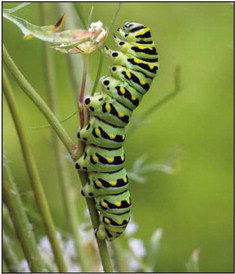
For gardeners who have plantings of the parsley family– parsley, dill, carrots, and fennel, or if they have Queen Anne’s lace, also known as wild carrot, in a nearby meadow–they may see a caterpillar like the one shown above, a black swallowtail caterpillar. This one is munching on Queen Anne’s lace.
Many gardeners love seeing this caterpillar and gladly let it feed on their plants, even planting extra especially for them. They don’t spend much time as a caterpillar, only three to four weeks. After that they find a sturdy stem or branch and form a pale green chrysalis, and in 10 to 20 days an adult black swallowtail emerges.
If the chrysalis is formed near the onset of cooler weather it may overwinter as a chrysalis and emerge the following year as an adult.
Look for these creatures in meadows and prairies, adding action and even more elegant colors to late summer.