
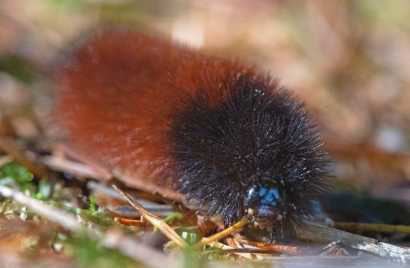
“We know they’re on the move these days, what we don’t know for sure is if they are carrying valuable information on their backs,” said Art Weber, Metroparks nature photographer.
Is that woolly bear caterpillar silently making its way across the driveway or across the road really trying to tell people something? Some say it is. Some say it’s telling us what kind of winter looms ahead. Will it be mild or harsh? They say the width of the brown band, between bands of black, is a measure of the winter to come. The more brown, the milder the coming winter will be.
But wait. There are some who say that it’s the other way around, the wider the brown, the harsher the winter. Still others say the width of all the bands tells us something. A wide band of black followed by a narrow band of brown and a wide band of black means a long hard start to the winter followed by a brief mild spell, and that is followed by more hard winter.
A biologist, finally tired of the conflicting woolly bear stories, decided to look into the phenomenon for himself. Charles Curran began studying woolly bears in 1948. Results for the first three years were encouraging. The caterpillars had wide brown bands, and, sure enough, there were three consecutive mild winters. But then it all fell apart. Exasperated, Curran gave up the study after finding two groups of caterpillars living near each other with conflicting bands.
The woolly bears seen now will overwinter as nearly mature caterpillars, transforming to an adult Isabella tiger moth next spring. Yep, that caterpillar that’s so familiar and loved by so many is destined to become a common nondescript moth,” said Mr. Weber who photographed this caterpillar.