
Every season, even winter, has its special qualities. There are advantages to an open, virtually leafless forest. Viewing is easier, and discoveries are there for those who are open to them.
In winter, it isn’t hard to see things that go largely unnoticed in other seasons. Walk any trail and be amazed how much is revealed and what has happened out of sight under cover of leaves.
Nesting songbirds are obviously long past the job of raising their broods. Many have fled southward to winter homes where food and weather is more amenable to survival. But their nests remain, and most are engineering marvels.
“Consider that meadow trail that you’ve walked multiple times in spring and summer,” said Art Weber, nature photographer. “Walk it now and maybe you’ll find a sparrow’s nest within arm’s reach of the trail, a small nicely shaped cup neatly formed from grasses and leaves. It raises the question of how many times you and others walked right past that nest when it was active, unaware that the young were there.”
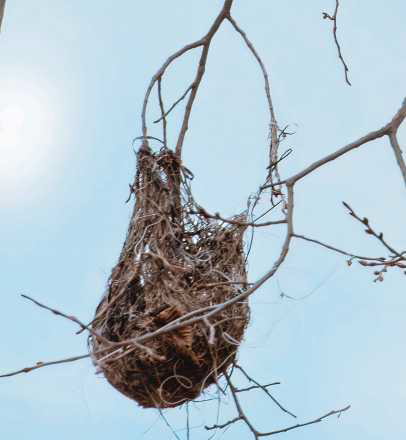
Look into the heights of taller trees, cottonwoods, for example. One might be rewarded with an avian engineering marvel, the hanging nest of a Baltimore Oriole. It’s a combination of structural materials, maybe fibers from milkweed stalks for structural strength, then lined with softer materials.
Below is a photograph, taken last summer by Mr. Weber, of a Baltimore Oriole nest. The pouch is strong enough to support the brood of a pair of Orioles. This one is in a tree canopy along the Maumee River at Side Cut Metropark.